So you have been convinced to play in the Games of the Harbingers. In order to do this you will need to make a character. A House Games character is known as a Highroller. For this guide, “Highroller” and “Character” will be used interchangeably. This guide will walk you through the Character creation process, step by step. Character creation can seem intimidating at first but once you’ve done it at least once its a breeze.
Character creation is done using this character sheet. It is an editable PDF and should be everything you need for your character. Make sure to save your file in order to save your sheet! Also feel free to print it out if you prefer. Its recommended to have this guide handy during character creation, and to save the PDF with the name of your character right at the very beginning if editing on a computer.
Important note: At creation Highrollers are always fully humans. A newly generated Highroller will not possesses any magic or supernatural powers.
Sample Highroller: Sam
This guide was written with new players in mind. Ill be making a character for this guide to help you follow along. My sample Highroller will be Sam, a stoic solider of fortune type who initially is loosely based off of the character Samus Aran. If you’re having trouble following along, just look at what I’m filling out and do the same with your own character concept. If you’re a veteran highroller, feel free to skip these segments.
Step 1: Concept
Note: This first step is largely for new players. If you have already made a character in the past and know what you’re doing, feel free to skip to Step 2.
House Games, as a system, has a few quirks that must be taken into account during character creation. World of Darkness (and by extension House Games) has a strong emphasis on story telling and character growth. However in House Games, each session is its own self contained story and might not have the same Story Teller. None of the sessions have an interconnecting plot by design. As such, here is a greater responsibility upon the player to take the initiative in driving the story and arc of their character.
Another quirk is that unlike D20 system such as Pathfinders or DnD, there is no class system in House Games. All there is are attributes, skills, and advantages. Truly the Marxist Dream, as you can build your character however the fuck you want.
Because of these two quirks, it is highly advised that you have a character concept in mind whilst making your Highroller. WOD is a storytelling focused game first and foremost. A strong concept is the engine that propels your Highroller’s growth forward, both mechanically and narratively. There are 3 ingredients that make a good Highroller concept.
1. The You you are.
Who are you? House Games, by the design, allow just about any type of character to be created and role played. Are you a heroic do-gooder who wants to change the world for the better? Are you a brutish thug who will take whatever you want? Are you a quick talking, morally grey trickster? Are you a sociopath with a twisted moral code presenting as a loving goofball? Are you a tortured artist looking for your next inspiration? Are you a solider haunted by the horrors of war, drifting your way through life?
Before you start filling in your stat blocks, have an idea in mind for who you are going to be. A well rounded Highroller is also a well developed character. What kind of personality do they have? What kind of upbringing did they have? What are their strengths and weaknesses? What kind of morality system do they have, and how strong is it? If they have regrets or traumas, what are they? What were some of the most pivotal moments of their life?
Try to have some of these answers going into your session 0. Part of your session 0 is a short role playing segment run by an agreed up Storyteller. The two of you will briefly go though the Highroller’s life, leading up to them being hired by the Harbingers. You’ll play through some key moments of the character’s life, in a sort of montage fashion. This will help you ease into playing your character, and could even help flesh out their backstory through collaborative story telling.
It should be noted that characters take time to flesh out. Have a good idea of who you are playing, but you don’t have to have all the answers immediately. A full biography of a characters life isn’t necessary.
This also where you can start filling out the first bits of your character sheet! (If you haven’t already started). This is where you can fill out the slots of Nature and Demeanor. These are both important for the roleplaying process, but they can be a little tricky to wrap your head around at first.
A character’s Nature is important to factor in for gameplay reasons. It is one of the way you can regain Willpower during session. A character’s nature is the dominant (but not only) archetype in their personality. Its a true reflection of their most closely held beliefs and thoughts. The function it serves in gameplay is reward you, the player, for roleplaying as your character by rewarding you willpower (at the discretion of the storyteller of course).
A character’s Demeanor on the other hand is the person they present to the world. The facade we present to outside. The demeanor of your highroller is not as important as their nature. We are constantly changing our presentation on a person on person basis, and this is our Demeanor. No person has a set demeanor, and feel free to change your Highroller’s Demeanor at any time. The Demeaner has no real effect on gameplay. Its just a little bit of flavor text to help you roleplay your character.
Sam’s Sheet
![[Screenshot of the example character sheet made for this guide. The following blocks are filled out and highlighted in blue:]
Name: Sam
Player: Eve
Reigion: Autism Limbo
Nature: Guardian
Demeanor: Quiet
Residence: Phoenix
Age/ Sex: 27/F
Ambition: [Left Blank]
Concept: Bounty Hunter/ Solider of of Fortune](/media/image-6-1024x109.png)
Having nailed down the general concept, I fill these boxes out on Sam’s sheet.
Now that we have these filled those out, you should be able to fill out all the basic bio information about your character (age, sex, name, etc.) Residence is just where in the world your character resides in. You can also fill out the concept, as this is the general idea you have for your character. Don’t worry too much about the region box, this is just the play group your part of.
However one slot you should put much thought into is your characters Ambition.
2. Ambitious and Tenacious
Every Highroller is unique. However they all have one thing in common: their insatiable drive and ambition. Each character should have a goal or set of goals that define them. The games are dangerous, but the rewards are great. Death is lurking in every corner and not everyone comes back from a job.
As fun as they are to play from as a Player, we must remember what it is like for our characters. The games are adrenaline fueled, terrifying ordeals for the characters. Once a month they are going on a job that will traumatize them. They make a Saw movie look like a walk in the park. Highrollers are risking life and limb (or worse) to earn the powerful gifts given to them.
Any complacent person would not partake in more than one game (if they’re even chosen to begin with). As such, the type of person who is likely to partake in a House Game is extremely ambitious. They have big picture, long term plans they wish to achieve. These are bigger plans than wealth, health or fame (all of which can be earned in single game.) This is a driving ambition to reshape the world as they see fit.
Creating a good goal is, without a doubt, the hardest part of Highroller creation. Even veteran players can have trouble with this. But the Goal is an intrinsic part of the concept, as it is the reason why your character continues to play the game.
A common trap is making a character with an Internal goal. Goals such…
- I want to be the best at XYZ
- I want to be the strongest Mofo in the Galaxy
- I want to be the richest person on Earth
- I want to be super famous and loved
…are not good goals to have. Some of these goals can be obtained after only a few games. Others ignore the fact that Highrollers are already extremely competent special snowflakes to begin with. All of these internal goals are not good for long term story telling. To what end would being the richest person on earth result in? What would you do with being the strongest Mofo out there? None of them generate conflict or change the world.
Instead it is better to have a goals that are external. Think about yourself for a moment. If you could have all the power to change the world, how would you change it? This is the kind of question you are answering. What does your character aim to achieve by playing the games? Your goal should lead to external conflict with the world and cause fundamental change to our world. Some examples of good goals are…
- I wish to achieve godhood and rewrite the world in my image
- I want to usher in a new dawn for humanity and colonize the stars
- I aim to wipe humanity from existence and reverse the damage its done to the Earth
- I work to destroy Capitalism itself, the very concept of ownership will be destroyed from the human psyche
- I will conquer the Earth, and see it into a new Golden Age of peace (or war?)
- I wish to alter the human race itself, to be a unisex species with no gender
There are some good examples of ambitions. These would fundamentally change history, humanity and even reality itself. These are all big picture goals that would invite conflict as your Highroller aims to achieve their goals.
Make sure that your goals are grounded enough to change the setting. However its also a good idea to make them too lofty to be easily (and fully) achievable. Highrollers can become ridiculously powerful, so a good character goal will invite conflict (the driving force of narrative) and be scale-able.
Finally its okay if your character goes into the house games not knowing what their end goal is. Your character can slowly realize their ambition over time rather than knowing right at the start. Maybe only once they realize the full power of the House do they start getting some big picture ideas. They can even change their ambition as their story develops. However, you as the player should have a clear idea what it is before their first game. A Highroller’s ambition defines their story trajectory. Fill it out on your character sheet in the Ambition box.
Sam’s Ambition
![[Partial screen shot of the character sheet for Sam. The following is displayed:]
Age/sex: 27 /F [Highlighted in a light blue]
Ambition: Root out injustice in the world, ushering in an age of piece
Concept: Bounty Hunter, Solider of Fortune [Highlighted in Blue]](/media/image-8.png)
For Sam, it took me a few minutes to think of a good goal. I’ve decided that she wants to root out injustice from the world. This can give me a lot of directions to take her story in, and like any noble crusader story is prone to lead to conflict.
Finally that takes us to the last main ingredient in concept creation.
3. Snowflakes of Carnage
Only the most strongest most gifted most special snowflakes protagonists are chosen to partake in the House Games. The harbingers only choose a hundred or so people out of thousands, and only a dozen or so people will survive more than a few years in the games. The games are a meatgrinder designed to make the cream of the crop. And you are the cream.
Basically, when your making a character, don’t make just an average joe. The person you are playing as is one of the absolute best in the world at at least one thing, if not more. You are given an absolutely absurd amount of points during character creation. Even if you’re not famous or successful, you are still extremely powerful and competent.
Just because you’re absurdly powerful doesn’t mean you cant be a character with depth and dimensions. An extremely skilled and talented individual a Mary Sue does not make. Think of characters such as Ripley, John Rambo, Ranni the Witch, Tony Stark, Furiosa, Edward Elric, Clarice Starling and Goku. All of them are extremely powerful and competent characters. And yet, all of these characters have depth, intrigue, flaws and growth.
Sam’s Progress
![[Screenshot of the example character sheet made for this guide. The following blocks are filled out and highlighted in blue:]
Name: Sam
Player: Eve
Reigion: Autism Limbo
Nature: Guardian
Demeanor: Quiet
Residence: Phoenix
Age/ Sex: 27 / F
Ambition: Ambition: Root out injustice in the world, ushering in an age of piece
Concept: Bounty Hunter/ Solider of of Fortune](/media/image-9-1024x108.png)
If you’re following along, this is what you should have finished on your character sheet.
Alrighty! That’s the hardest part of character creation done. Making a concept can be a lot of leg work, but its important as its the foundation our entire character sheet is built on. Now that you know who you’re playing narratively, its time to build a stat block for the person your playing to reflect mechanically in the game. Everything else should be easier from here.
Step 2: Attributes
Now we can finally begin filling out the character sheet and their dice pools. If you don’t know what dice pools are and how they work in WOD then here is an explanation. It is highly recommended new players familiarize themselves with how they work prior to stat allocation.
As you begin filling out your stat block, don’t worry about making your concept super duper min maxxed. You’ll get a generous amount of freebies at the end to assign however you wish.
We will begin with Attributes. Attributes are the characters innate natural born talents, and everyone starts with 1 in every category. The higher your score is in an attribute the better you are at it. 1 is far below average, whilst 5 means you are one of the best in the world. For more information about attributes, there is a page detailing the nuances of each one.
Attributes: 7/5/3
Attributes are divided into 3 groups: Physical, Social and Mental. Spending 1 point raises each attribute by 1 point. You may spend 7 points on one group, 5 points on another, and 3 on the last group. No trait can be raised to higher than 5 during character creation.
Sam’s Attributes
![[Previously shown character sheet for now with the attributes shown and filled in. The following attributes are assigned to Sam:]
[Physical column]
Strength 3
Dexterity 4
Stamina 3
[Social Column]
Charisma 2
Manipulation 1
Appearance 3
[Mental column]
Perception 3
Intelligence 2
Wits 3](/media/image-13-1024x264.png)
Sam is a bounty hunter, so she above all needs to be good at physical activity. I decided to put 7 points into the Physical category. Like wise, she also needs to be quick on her feet and perceptive; so I put 5 points into the Mental category. However, Sam is the strong stoic type, not really a people person. Social skills aren’t as important to her, so I put only 3 points into her social attributes. If I feel I need to raise any of these attributes to fit my concept, such as intelligence or appearance, I can always use some of my freebie points later to do so.
Step 3: Abilities
Abilities are things you pick up and learn as you get older and wiser. Like attributes, they are divided into 3 categories: Talents, Skills and Knowledge. They represent the things you know how to do. Just like Attributes, the higher your score; the better you are at it. Unlike attributes, all abilities start at 0. If you’d like to know about the nuances of each ability, they have their own dedicated page detailing all of them in depth.
Abilities: 13/9/5
Just like attributes, you get a set amount of points to spend on each of your abilities. Each ability starts at 0, and spending 1 point increases the ability by 1. You may spend 13 in one group, 9 in a second group and 5 in a third group. No trait may be raised above 5 during character creation. If you have a 5 in any given skill, your allowed to take a specialization in that given skill.
Sam’s Abilities
![[Previously shown character sheet for now with the abilities shown and filled in. The following abilities are assigned to Sam:]
[Talents]
Alertness 3
Athletics 3
Dodge 3
Endurance 2
Intuition 2
[Skills]
Firearms 5
Pilot 2
Stealth 2
[Knowledge]
Computer 1
Investigation 3
Linguistics 1](/media/image-14-1024x515.png)
In order to represent her high physical aptitude, I put 13 points into Sam’s Talent column. She is very good at dodging, alertness and athletics, whilst also being component at endurance and intuition. Paired with her high physical and mental stats, Sam’s strong and quick on her feet. In her Skills column I allocated 9 points, dumping 5 into firearms. Given her high Dex and firearms traits, she is an Olympic tier marksman capable of handling any firearm. She takes a specialization in marksmanship. She also has points in stealth and pilot, meaning she’s good at sneaking around and operating vehicles. Finally I put 5 points into her knowledge column, mostly into investigation. She’s above average at it, and it’ll pair well with her skills in perception and wits. She also conversational in a second language (we’ll say Spanish) ; and knows one or two advanced computer techniques. However she has almost no social, knowledge or crafting skills. She’s a shoot first, questions later kind of woman. Just like attributes, I can always raise any of these traits with freebie points later.
Step 4: Virtues
The next step is allocating our 3 virtue stats: Conviction, Self-Control and Courage. These are all related to your characters mental fortitude, determination and mental health. They also determine your starting Willpower and Morality. These 5 traits are all fairly self evident but each has its nuances:
Nuances of Virtues
Conviction is your dedication you have to your ideals and your mental fortitude. It also contributes to your starting Morality. When you violate your own ethics, make sanity checks, or must justify your actions to yourself you may need to roll conviction.
Self-control is your ability to stay composed under stress, resist temptation and keep a grip on reality. Like Conviction, it contributes to your starting Morality. When you witness horrifying scenes, must am tempted by urges or are hit with powerful cravings self control must be rolled.
Finally Courage is the gravel in your guts and the spit in your eyes. Faced with a terrifying situation, about to do something extremely dangerous (or stupid)? Roll for courage. Your starting Willpower is equal to your Courage.
Willpower is a powerful stat that lets you alter rolls and outcomes during a session. See Willpower for more information. Morality will be explained further on in this guide.
Virtues: 7 points
You may allocate 7 points amongst your 3 virtue stats. They all begin at 1. You may spend one point to increase each stat by 1.
Morality and Willpower
After assigning Virtues, calculate your Willpower and Morality stats. Your starting Willpower is the same as your Courage. Your starting Morality is equal to your Self-control + Conviction. This represents how strong (or weak) your character’s Moral Compass is.
See Morality for more information on the Morality System.
Note that increasing any of your Virtues later does not increase your Morality or Willpower.
Sam’s Virtues
![[screenshot of Sam's Character sheet. She has the following points allocated.]
Willpower 3
[Virtues]
Conviction 2
Self-Control 4
Courage 3
Morality 6](/media/image-16.png)
For Sam’s virtues I allocated 1 point to Conviction, 3 points to self control and 2 points to Courage. This gives her 3 Willpower Points to spend and a starting Morality of 6.
Step 5: Background
Backgrounds are the resources, contacts, perks, and status your character has access to. These can occasionally be rolled for as if they were traits (for example using Fame + Charisma to charm your way into a nightclub.) They also are utilized during downtime and side sessions between games to help generate story, traits, and resources for your character. Don’t worry too much about min-maxxing your Backgrounds right now; they are very easy to buy with Freebie points.
Backgrounds: 5 points
You may allot 5 points into any of your backgrounds. Like other traits, backgrounds scale from 0-5.
See also: Starting Backgrounds. for a full, detailed list of all backgrounds available to you at character creation.
Please note that if you do not take any points in the Resources background you will effectively have no sustainable income. You will begin with 1d10*10 in cash and will be unable to replace equipment or afford transportation.
Sam’s Background
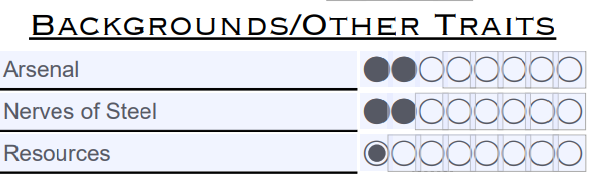
My fantasy for Sam is that of a down on her luck vigilante bounty hunter. Being down on her luck, she only has a resource of 1, which means shes just barely breaking even each month. Being so, she does have an arsenal of 2, which can include restricted gear and police weaponry.
Its about here I have the idea for her to be a former cop. To help justify this, a gave her Nerves of Steel 2 to reflect police academy training and seeing action.
Step 6: Freebie Points
Freebie points are extra points allotted to the player to spend however they wish. If spent wisely they can make a character very strong right at creation. They can be spent improving any trait of your character. Merits (strong game altering traits) can only be bought with Freebie Points and its recommended you take at least one. (Merits will be detailed later on in this step)
Flaws
Some of the cheaper flaws can be negated after only one or two games, or even be boons if played correctly. The most expensive Flaws will dramatically change the way you must play the game both, narratively and mechanically.
It is highly recommended you take at least one flaw.
Nuances of Flaws
There are two incentives to take flaws. The first reason is mechanical, taking flaws gives you more Freebie Points to work with. Freebie Points are a powerful resource that will massively boost the base power level.
The second incentive is flavorful, it lets you have a mechanical reflection of the fantasy you are trying to roleplay. It was discussed in step 1 how a powerful character a Mary Sue does not make. Flaws are a mechanical reflection of the torment and challenges your character faces.
Some flaws can also be inflicted through gameplay. Seen some shit? Might end up with nightmares. Get your legs torn off your torso? You might end up being a paraplegic.
It is highly recommended that you take at least one flaw during character creation. The freebie points are absolutely worth it. Do not worry about the long term consequences, many flawed can be removed after just one game session.
You make take 7 points worth of Flaws at character creation, or two Flaws totaling any amount. See Starting Flaws for a full, detailed list of all Flaws available to you at creation.
Sam’s Flaws
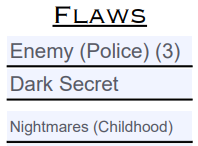
I decided I wanted to make Sam a former cop, and flaws are a great way to flesh that out! I settled on her leaving the force for fragging her CO due to his corruption. As such, the local police are out to get her, making them her enemy. Though she’s wanted, Notoriety doesn’t quite fit the fantasy I’m going for. Instead we will have this be a Dark Secret.
Finally in my mind, Sam was initially drawn to the police as a way to deliver justice. I’ve decided part of her motivation for this was an abusive childhood. Flaws are the perfect way to reflect this. Twisted Upbringing could be a choice, but doesn’t reflect the driving sense of justice Sam has. Instead I choose to take Nightmares in order to represent her childhood trauma.
All in all this gives me 5 additional Freebie Points to use.
Freebie Points: 15 + Flaw Values
You are allotted a base amount of 15 Freebie Points, plus the value of any Flaws taken. You may spend these Freebie Points however you see fit. However price to increase various traits via Freebie Points is different than during the rest of Creation. The cost to increase a trait by 1 point using Freebie Points (FP) is as follows:
- Attributes: +5 FP
- Abilities: 2 FP
- Virtues: 2 FP
- Morality: 2 FP
- Backgrounds : 1 FP
- Willpower: 1 FP
- Merits each cost a different amount
Merits
Merits are the opposite of Flaws. While Flaws are crippling in nature, Merits are powerful boons that dramatically increase the effectiveness of your Highroller. Like Flaws, the more points a Merit costs the more powerful it is. Unlike Flaws, even the cheapest Merits are useful for your characters entire run.
It is highly recommend you take at least one Merit.
Note that many Flaws and Merits are opposites of each other and thus can not be taken together. For example the Merit Concentration and the Flaw Absent Minded are mutually exclusive. This will be listed on a case by case basis. There are also few Merits that are mutually exclusive to each other, due to their overpowered synergy. The main example of this are the Merits Luck and Charmed Existence. These will also be listed on a case by case basis.
See Starting Merits for a full list of Merits available to the Player at character creation.
Sam’s Merits and Freebie Allocation
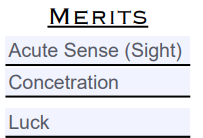
Going into Freebie Allocation I have 20 Points to work with. There’s a lot I can do with this. Its a good idea to start with Merits, as they are the most affordable at character creation. Sam is an exceptional sniper, so I give her Acute Senses (Sight) and Concentration to make her even better at shooting. I also give her Luck, which is just good to have. I now have 13 Freebie Points to finish out her Stat block.
It can be a good idea to pick up some more backgrounds too. I decide to increase Arsenal to 3 to give Sam access to some heavier firepower. At this point I’ve landed on Sam being a sniper when she was swat, so I give her a 3 in Lethal Accuracy.
Step 7: Inventory
Now that you have assigned all of your stat blocks it’s time for the final step of character creation: inventory. Inventory in house games follows a simple rule, observed since the start of our tradition:
IF YOU DONT HAVE IT WRITTEN DOWN, YOU DON’T HAVE IT
Write down on your sheet everything your character might reasonably carry with them on a mission. Begin with their daily carry items (wallet, keys, cigs etc) and go from there. Be sure to write down their outfit as well.
Do try to be reasonable with this. Keep in mind that WOD is a low fantasy setting, meaning it is set in our own world. If you’re walking with a .50 cal machine gun, most people are going to raise an eyebrow and treat you differently. Likewise you won’t be able walk around with mountains of items. You won’t be able to walk around with 10 cheese wheels and 13 swords in full plate armor whilst unencumbered. Just be reasonable about your characters items. If you abuse or bend the rules in bad faith expect to get vetoed or punished by a Storyteller.
That pretty much sums up character creation. Congratulations on finishing your High roller! This guide is currently a work in progress but is complete enough to be used to create a character. Hope you enjoy playing House Games!